

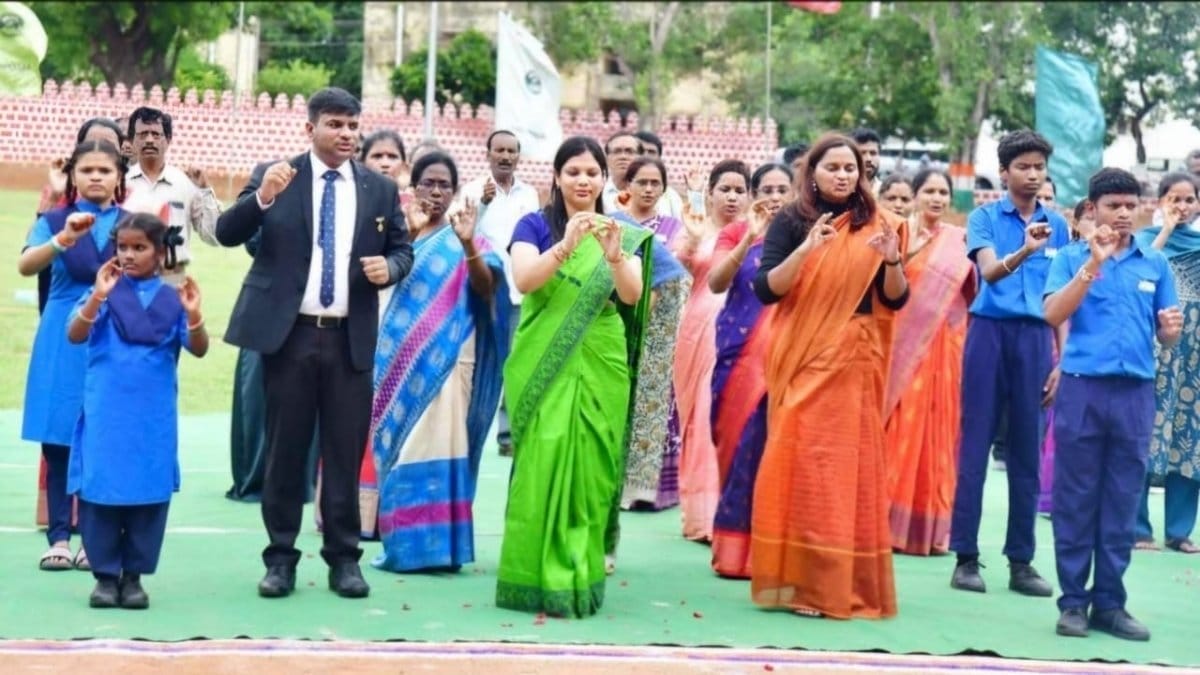
Hyderabad (Telangana) [India], September 1: Karimnagar set a remarkable precedent for the nation this Independence Day when the National Anthem was performed in Indian Sign Language (ISL) at the main ceremony in Karimnagar. District Collector Pamela Satpathy led a group of children with hearing impairments in rendering Jana Gana Mana through graceful signs, leaving thousands present at the police parade grounds deeply moved.
What could have been a routine ceremony became a powerful symbol of inclusion, unity, and dignity. This event marked a historic moment for Telangana, where governance, empathy, and constitutional values converged on one stage.
The Constitution of India, in Article 51A(a), makes it the fundamental duty of every citizen to respect the National Flag and the National Anthem. Often, this is observed only through ritualistic gestures—standing in silence or singing in unison. But in Karimnagar, the anthem was not just sung, but felt, proving that respect for national ideals is not limited to words or sound.
By enabling children with hearing impairments to take center stage, the administration provided a living interpretation of constitutional values, demonstrating that true patriotism lies in ensuring equal participation for all citizens.
This moment was also a practical implementation of the Rights of Persons with Disabilities (RPwD) Act, 2016. The Act emphasizes non-discrimination, accessibility, and equal opportunities, shifting disability rights from a welfare approach to a rights-based framework.
- Non-discrimination: The anthem in ISL ensured children with hearing impairments were not excluded from a national ritual, but instead made central to it.
- Accessibility: By training district officials in ISL, the administration addressed an often-overlooked barrier—communication. Beyond ramps and elevators, accessibility also means that information and services must be understandable to everyone.
- Inclusion: The decision to feature specially-abled children on the main stage reinforced their rightful place in society, in line with the Act’s vision of a barrier-free India.
From a governance perspective, the initiative reflects a shift toward citizen-centric administration. Instead of a top-down approach, where rules dominate interactions, this was a needs-based reform tailored to the lived realities of the deaf community.
The cost was minimal—training officials in basic sign language—but the impact was transformative. It reduced dependency on intermediaries, ensured last-mile connectivity to government services, and fostered a sense of belonging among marginalized groups.
Such micro-level administrative innovations show how governance can be compassionate without being expensive. They also serve as a reminder that empathy in governance is as important as efficiency.
The initiative also speaks volumes about the emotional intelligence and integrity of those leading it. Collector Pamela Satpathy’s decision to highlight ISL went beyond the call of duty. It was an act of compassion that respected the dignity of children often excluded from mainstream celebrations.
By creating space for them at the heart of a national ritual, the administration demonstrated that governance is not just about enforcing laws—it is about building trust, dignity, and pride among citizens.
Indian Sign Language is more than a communication tool; it is a complete language with grammar, syntax, and culture of its own. Its recognition as an official language in 2021 was a landmark for the deaf community.
Institutions like the Indian Sign Language Research and Training Centre (ISLRTC) are working to standardize and promote ISL nationwide. The Hyderabad region’s initiative shows how national policies can find meaningful expression at the local level, making India’s democracy more inclusive.
The “Silent Anthem” has set a benchmark that other districts and states can emulate. It proves that patriotism is inclusive and that celebrations of national pride must leave no one behind.
For civil servants, this event is a case study in ethical and empathetic governance—a reminder that their role extends beyond maintaining order to nurturing an inclusive society. For citizens, it is an invitation to broaden the meaning of national pride—moving from symbolic reverence to active participation in building a just, accessible India.
The Hyderabad-led initiative transcended a ceremonial act. By blending constitutional values, social justice, and governance reforms, it became a blueprint for inclusive nation-building.
The anthem performed in silence carried a profound message: every citizen, regardless of ability, is a part of India’s journey forward. True respect for the nation lies not in the volume of our voices but in the depth of our inclusion.
As the last notes of the silent anthem echoed across the grounds, it was clear—sometimes, the loudest declarations of patriotism are those made in silence.
If you have any objection to this press release content, kindly contact pr.error.rectification@gmail.com to notify us. We will respond and rectify the situation in the next 24 hours.
